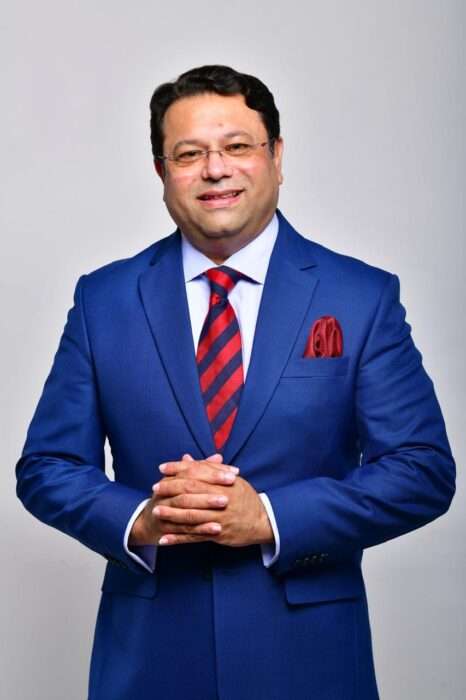
At a time when Mauritius faces increasing public demand for accountability, transparency and meaningful reform, voices that combine legal expertise with political experience are playing an increasingly important role in shaping national discourse. Among them is Kushal Lobine, Barrister-at-Law, Member of Parliament and leader of the political party, Nouveaux Démocrates.
Currently serving as an elected representative for Constituency No. 15, La Caverne and Phoenix, Kushal Lobine brings to public life a perspective grounded in both legal practice and parliamentary experience.
Lobine’s journey from the legal profession into active politics is rooted in a clear conviction: that while the law provides the framework for justice, politics is where the direction of that framework is determined. His approach to public service is shaped by a commitment to principled leadership, consistency in values and a willingness to challenge established norms in pursuit of reform.
In this interview, he reflects on his early influences, his transition from law to politics, the realities of navigating the political landscape and his vision for rebuilding trust and advancing institutional, electoral and socio-economic reform in Mauritius.
Can you briefly tell us about your early life and what inspired you to pursue law and politics?
I come from a background where education, discipline and service to society were deeply valued. From an early age, I developed a strong interest in understanding how systems function — particularly the role of law in shaping people’s lives.
Pursuing legal studies equipped me with the ability to think critically, challenge authority where necessary and advocate for fairness and justice. Over time, I came to realise that while the law is essential in interpreting and applying rules, politics is where those rules are created. That is ultimately where meaningful and lasting change begins.
What motivated your transition from a legal career to active politics?
My experience in the legal field exposed a significant gap between the theory of law and its practical application. I witnessed firsthand how policies impact ordinary citizens — sometimes positively but often with unintended consequences.
This realisation made it clear that achieving meaningful reform requires active participation in the policymaking process. Transitioning into politics was therefore a natural progression, allowing me not only to interpret the law but also to contribute to shaping it in a way that better serves society.
You’ve been part of multiple political parties — what has driven your shifts in allegiance?
My guiding principle has always been rooted in values rather than labels. Political alignment, in my view, should never be based on loyalty to individuals or structures but on a steadfast commitment to ideas such as integrity, fairness and progress.
When those values are no longer reflected within a platform, it becomes both responsible and necessary to reassess one’s position. My journey may show changes in affiliation but it reflects a consistent adherence to core principles throughout.
What challenges have you faced in your political career, and how have you overcome them?
Politics is inherently challenging, particularly when one seeks to question or reform established norms. Among the most significant obstacles I have encountered are resistance to new ideas, instances of misrepresentation and at times, pressure to conform.
Overcoming these challenges requires resilience, a clear sense of purpose and a strong connection to the reasons one entered public life in the first place. I have consistently relied on thorough preparation, transparency in my actions and a commitment to consistency in order to navigate these complexities.
How would you assess the current political climate in Mauritius?
Mauritius is currently at a critical juncture. While the population is increasingly politically aware, there is also a growing sense of frustration — particularly among younger citizens — regarding issues of representation, accountability and access to opportunities.
There is a perception that the political system has not evolved at the same pace as society itself. This situation presents both a challenge and an opportunity: a challenge because public trust is being tested but also an opportunity, as citizens are becoming more engaged and open to meaningful reform.
Do you believe public trust in politics is improving or declining?
On balance, public trust has been declining. However, this trend is not irreversible. Citizens are not disengaged; rather they are demanding higher standards — greater transparency, authenticity and tangible results.
Rebuilding trust will require more than rhetoric. It must be earned through consistent, credible action over time. Only then can confidence in public institutions be restored.
How can political leaders better connect with the population?
Meaningful connection requires more than visibility — it demands authenticity. Leaders must be willing to listen actively, engage with citizens beyond electoral cycles and communicate in a way that reflects people’s everyday realities.
Accessibility is equally important. Being present, accountable and responsive helps foster trust. Ultimately, citizens need to feel that their concerns are not only heard but that they play a genuine role in shaping policy decisions.
What reforms would you prioritise if given the opportunity?
I would prioritise three key areas.
First, institutional reform: strengthening transparency, accountability and the independence of key institutions to reinforce public confidence.
Second, electoral reform: ensuring fairer representation while maintaining the social cohesion that is fundamental to our national identity.
Third, advancing economic and social equity: through policies that address the rising cost of living, expand opportunities for young people and provide stronger support for vulnerable groups.
These reforms are essential to building a system that is both modern and inclusive and one that responds effectively to the evolving needs of society.
RUQAYAH B. KHAYRATTEE