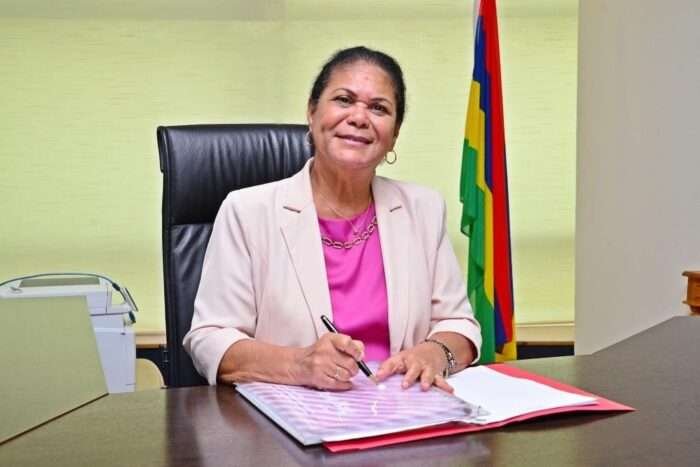
As Mauritius marks the International Day for the Elimination of Violence Against Women on 25 November, under this year’s theme, “Pa tou blesir ki vizib” (Not All Wounds Are Visible), attention turns to the forms of abuse that often remain hidden behind closed doors. Four months after Parliament voted the Domestic Abuse Bill with rare cross-party consensus, Mauritius’ first woman Deputy Prime Minister, Hon. Arianne Navarre-Marie, reflects on the changes introduced by the new law, the realities women continue to face and the challenges of ensuring that protection translates into meaningful action. From psychological and economic abuse to social attitudes, men’s responsibility and the importance of educating future generations, she discusses the work that remains to ensure that no woman has to suffer in silence. She also reflects on her personal journey, from her childhood in Dockers Flat to becoming the country’s first woman Deputy Prime Minister.
Four months after Parliament voted the Domestic Abuse Bill, what has concretely changed for a woman who walks into a police station today?
On 10 July 2026, the National Assembly voted the Domestic Abuse Bill, which came into force on 14 September 2026. When I presented it to the House, I said that this text was our commitment to turn pain into protection, silence into justice and despair into hope. I also made a commitment that I will continue to uphold for as long as I hold this office: never again should a woman die in this country despite all the warning signs being there in plain sight.
Concretely, a woman can now lodge her complaint at any police station in the country. The court has seven days, instead of fourteen, to summon the alleged abuser and examine her application for a Protection Order. That order is reviewed every three months.
Above all, the abuser, rather than the victim, can be ordered to leave the family home, regardless of who owns the property. For too long, it was the woman and her children who had to pack their belongings and leave, sometimes in the middle of the night. That logic is over.
Breaching a Protection Order now carries a penalty of up to Rs 50,000 and one year of imprisonment for a first conviction, rising to up to ten years of penal servitude from the third conviction. Domestic abuse is a crime, and it will be punished as one.
This year’s International Day theme is “Pa tou blesir ki vizib”. Why is it important to recognise forms of domestic abuse that leave no visible marks?
Because the old law was looking for bruises. We deliberately chose the term “domestic abuse” rather than “domestic violence”. In most people’s minds, violence is associated with physical blows. But a woman can be destroyed without a single mark on her body.
It can happen through repeated humiliation, a husband confiscating her salary, bank card or phone, a partner tracking her every move and reading her messages or threats made through social media.
The Act now recognises psychological, emotional, economic, digital and coercive abuse. I told Parliament that manipulation and coercion deserve the same legal weight as a punch. Withholding a pension or someone’s financial resources is now an offence.
A few days after the vote, the Criminal Code was amended to recognise marital rape. Marriage is no longer a shield.
On digital violence, we launched an online safety campaign for children and adolescents last December, in collaboration with the United Nations, the Ombudsperson for Children and the Ministry of ICT. In October, we brought Meta around the table and new legislation on online violence is being prepared.
On paper, a law does not save lives. How do you make sure it works on the ground?
I said exactly that in Parliament. In 2025, 221 of the 986 applications for a Protection Order were withdrawn. Not because the danger had necessarily disappeared but because of fear, financial dependence or family pressure. Every withdrawal of a Protection Order application now goes to the Director of Public Prosecutions, who can order a further enquiry before anything is decided.
In March, two experts from SafeLives, with the support of the British High Commission, trained our first responders over five days. Since the Act came into force, we have also been training police officers, prison and health personnel, social security officers and NGOs.
Our services have been regrouped into 12 Family Support Services (FSS), where a woman can find psychological follow-up, legal aid and assistance with her sworn statement under one roof. A Domestic Abuse Coordinating Panel and Multi-Agency Risk Assessment Committees are intended to put an end to institutions working in silos. Furthermore, any professional with reasonable suspicion of abuse now has a duty to report it.
We must also address financial independence. A woman who cannot afford to pay rent may eventually return home. The State now covers the first two months of a shelter stay for her and her children. Rs 10 million has also been allocated to the Half Way Home, and we have reopened the Women Empowerment Centres at Camp La Boue, Richelieu and Triolet.
In 2025, the National Women Entrepreneur Council trained 869 women entrepreneurs. With Expertise France and the Lumin’Îles project, we are also working on childcare, because a woman who has nowhere to leave her children has no real choice.
Our partnership with the MBC and the national campaign will help ensure that every woman knows one important number: 139.
Why are women who report abuse sometimes questioned more harshly than the people they accuse?
Because our society still asks the wrong questions. Instead of asking, “Why did he hit her?”, we ask, “What did she do?”, “Why didn’t she leave earlier?” or “Why is she only speaking now?”
That suspicion exists at the police counter, within families and in the comments under news reports. A woman who has finally found the courage to speak out can end up facing a second form of violence: disbelief.
Invisible wounds make the situation even more difficult. When there are no bruises and no visible signs, women are often doubted. That is precisely why the law recognises psychological and economic abuse, and why we train frontline officers. The first response a woman receives can determine whether she comes back for help or falls silent for good.
Let me be clear: Every complaint deserves to be treated with seriousness and respect. While allegations must be properly investigated, no woman should be made to feel humiliated for coming forward.
We teach girls to protect themselves but are we doing enough to teach boys to respect women? Where are we failing?
We have placed the whole burden of safety on girls: don’t walk home alone, don’t dress like that, don’t answer back. We rarely tell boys that no means no, that jealousy is not love and that checking someone’s phone is not an expression of protection.
That is where we fail and it starts at home.
During the parliamentary debate, I shared the words of a little boy to his father: “Pa, to bizin pa bat mama, to pou al dan prizon”. No child should ever have to say that. A boy who grows up watching his mother being humiliated risks repeating that behaviour. A girl growing up in the same environment risks accepting it.
That is why we work with men, not against them. Our Men as Caring Partners programme reached 309 men in 2025 and in November last year we launched “Men as Allies” at the Camp Yoloff community centre. Our Parental Strength Circles also help parents rebuild the family from within.
Most men are not violent. I need them to speak up when a friend, a brother or a colleague crosses the line. The silence of men protects abusers.
As Minister, what is the one change you want to bring about that would make a real difference in the life of a woman facing abuse?
That no woman ever has to withdraw her complaint again because she has nowhere to go and nothing to live on.
Remember those 221 withdrawals. Behind each one, there is often a woman who has calculated that the street is more dangerous than the man.
If I can guarantee her a roof, an income, a place for her children and a professional who believes her from the first minute, then the law will truly protect her.
Everything I do in this Ministry comes back to that.
As Mauritius marks the International Day for the Elimination of Violence Against Women, what message would you give to women suffering in silence?
You are not alone and it is not your fault.
What you are living has a name and since 14 September it is a crime, even if no one sees your wounds. Insults, threats, control and money taken away are all forms of abuse.
Talk to someone you trust. Call 139. Walk into any police station or any Family Support Service.
The State is on your side now. Abus domestik se enn krim, proteksyon se enn drwa pu tou dimoun. (Domestic abuse is a crime, and protection is a right for everyone)
When you look back at the road from your childhood to becoming Mauritius’ first woman Deputy Prime Minister, what does success mean to you today?
I grew up at Dockers Flat, in a family of Chagossian origin. My father was a docker. My mother never had the chance to go to school. Women like her held whole families together, often in silence and often carrying wounds no one ever saw. I think of them whenever I say “Pa tou blesir ki vizib”.
So, success, for me, is not the title. It is a woman who tells me she found the strength to leave and that her children now sleep in peace. It is a girl from a “cite” (suburb) like mine who believes that no door is closed to her.
The day women in this country no longer need courage to be believed, I will feel I have done my job.
RUQAYAH B. KHAYRATTEE