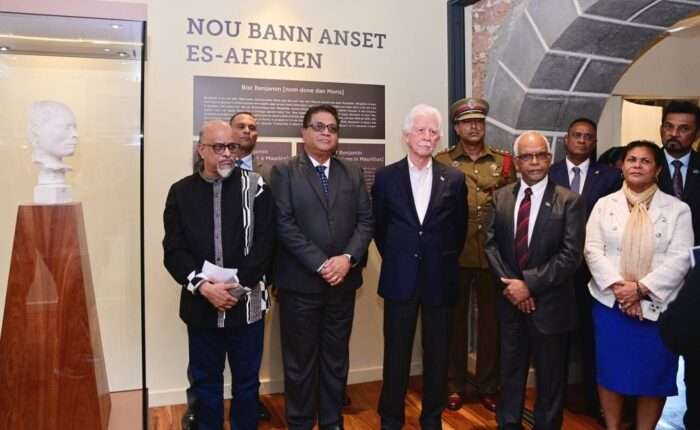
At the Intercontinental Slavery Museum (ISM) in Port Louis, on Tuesday 19 August 2025, both the President of the Republic of Mauritius, Mr. Dharam Gokhool and the Acting Prime Minister, Mr. Paul Raymond Bérenger, emphasized the importance of understanding the history of slavery and its lasting impact on the nation’s social fabric.
The call for the population to engage deeply with the nation’s past was made during the launch of a week of commemorative events held from 19 to 23 August 2025, in observance of the International Day for the Remembrance of the Slave Trade and its Abolition. Several Ministers, Junior Ministers, Members of Parliament, members of the Diplomatic Corps and other dignitaries attended the ceremony.
Established by UNESCO in 1997, the International Day for the Remembrance of the Slave Trade and its Abolition falls on 23 August each year. It commemorates the transatlantic slave trade, one of the darkest chapters in human history, during which over 400 years, between 25 and 30 million people were forcibly uprooted, torn from their loved ones and transported from Africa to the Caribbean and the Americas to endure brutal servitude and inhumane conditions.
In his speech, the President highlighted the critical role of historical awareness in shaping the future of the nation. He stressed that it is essential for the people of Mauritius to confront and understand the full scope of their history, which has contributed to the country’s unique multicultural identity.
The President also expressed gratitude to those dedicated to uncovering the truths of Mauritius’s darker chapters, particularly researchers and academics whose work helps to shed light on the complexities of the nation’s past. Their efforts, he noted, are vital in unveiling the pivotal events that have shaped the social and cultural fabric of the country.
The Acting Prime Minister, for his part, reflected on the resistance to slavery that began during the Dutch colonial period. He spoke of the silent revolts and insurrections that persisted despite heavy repression. He emphasized that resistance movements were active and that slaves and indentured laborers were not passive, as often believed. Mr. Bérenger affirmed that the struggle for freedom, which predates the formal abolition of slavery, is a fundamental part of Mauritian society’s very fabric.
Highlighting the often-overlooked stories of rebellion, the Acting Prime Minister underscored the resilience and fighting spirit of those who fought for their dignity. He also touched on the themes of reparations, restitution and return, noting that Mauritius, as a member of the African Union and a nation shaped by slavery and indentured servitude, can and should participate more actively in the ongoing conversations about historical justice related to slavery.
The official launch of the commemorative activities included the unveiling of the ‘Vizaz nou Zanset’ (Faces of our Ancestors) exhibition, which features plaster busts of East African slaves created in the mid-19th century by ethnographer Eugène Huet de Froberville. Some of these busts, which were moulded from living individuals, will be exhibited to the public for the first time in Mauritius.
Another feature of the opening ceremony was the temporary exhibition, ‘Représentation Iconographique de l’Insurrection de 1695’ (Iconic Representation of the 1695 Insurrection). Students from the Mahatma Gandhi Institute contributed visual artworks interpreting the 1695 uprising, when enslaved individuals revolted against their Dutch colonial captors at Fort Frederik Hendrik in Vieux Grand Port.
Furthermore, the event marked the official launch of ‘Tras Interkontinantal’, a new publication by the ISM. This newsletter aims to inform and engage the community about the museum’s mission, making knowledge about slavery more accessible and connecting it with contemporary issues related to this historical reality.